Brian Tyree is a sports writer and sports opinion writer covering all major American sports, and the convergence of sports and politics.
MLB ABS: The Enemy of the Perfect Pitch
By Brian Tyree
Sports Writer
The much-anticipated automated ball-strike system (ABS) debuted this week in Major League Baseball, but it contains a dubious and intentionally hidden flaw: the outlawing of the “perfect pitch.”
In the bottom of the seventh inning, Boston Red Sox reliever Justin Slaten squared off against Cincinnati Reds catcher Tyler Stephenson. Slaten hurled what he thought was a perfect pitch — a breaking ball that started high out of the strike zone until the bottom fell out, dropping through the zone.
“Ball” was the call from the home-plate umpire, triggering a challenge from Red Sox catcher Connor Wong. The ABS animation played on the scoreboard and for those watching at home, displaying “BALL,” and the call was confirmed.
But Statcast told a different story.
Statcast, an evolving technology created in 2006 and owned by MLB Advanced Media, uses 12 high-speed cameras in every ballpark in the majors. It is the 3D data authority that calculates every inch of the ball’s journey at 300 frames per second. ABS is a simplified 2D layer of that data that only “looks” at a paper-thin 2D plane at the center of the plate.
In other words, ABS only sees a slice of the middle of the plate and is completely blind to the full depth, width, and height of the front and back. It is an intentional flattening “glitch” authorized by the MLB Joint Competition Committee.
The committee deliberately chose this flat 2D plane in the middle of the strike zone to prevent the computer from calling “technically correct” strikes that look like balls to the human eye.
“Throughout this process we have worked on deploying the system in a way that’s acceptable to players,” MLB Commissioner Rob Manfred said in a statement to The Associated Press. “The strong preference from players for the challenge format over using the technology to call every pitch was a key factor … we have worked at every step to make the game better.”
ABS cameras use Hawk-Eye technology. The professional tennis world uses Hawk-Eye Live for its electronic line calling. Unlike MLB’s limited use, professional tennis uses the full 3D technology. They don’t “clip the wings” of the technology to get the call right and reward pitchers throwing the perfect pitch.
In the first week of MLB play alone, there were four casualties of the inaccurate ABS rulings that were definitively proven correct by Statcast.
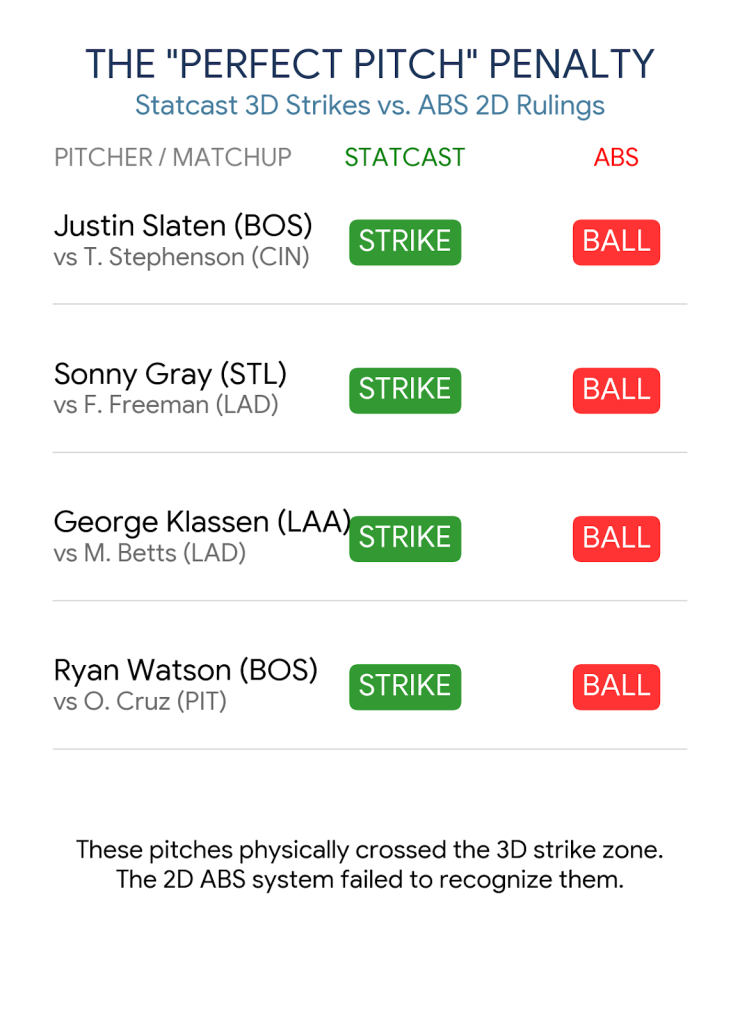
“It’s a tough pill to swallow when you see the ball pass through the zone on the replay but the computer says otherwise,” Slaten told reporters after the game. “The goal of the pitcher is to throw what looks like a ball to the hitter and have it drop into the zone. When you freeze a guy like that, it’s the perfect pitch. But under this system, it’s a wasted one.”
SRY not SRY: IOC Mandates Gender Tests for Female Olympic Athletes
By Brian Tyree
Sports Writer
Men pretending to be women to legally pummel them in women’s Olympic boxing is now a violence of yesteryear. Thanks to mandatory gender verification implemented by the International Olympic Committee, or IOC, the era of self-identified “athletes” compromising the female category has come to an end.
The testing applies to all women’s categories. The policy is effective immediately and will be implemented for the 2028 Summer Olympics in Los Angeles. The mandate relies on SRY, or Sex-determining Region Y, tests to identify the presence of male-typical genetic material.
On March 26, 2026, the IOC released an official policy document, “Protection of the Female (Women’s) Category in Olympic Sport.” The SRY gene is the fundamental biological determinant for athletic eligibility: “Eligibility for any female category event at the Olympic Games or any other IOC event, including individual and team sports, is now limited to biological females, determined on the basis of a one-time SRY gene screening.”
The IOC moved away from hormone screening in favor of SRY testing, stating: “The presence of the SRY gene is fixed throughout life and represents highly accurate evidence that an athlete has experienced male sex development.”
The SRY gene, located on the Y chromosome, triggers the formation of testes and the production of testosterone levels associated with male puberty. The IOC identifies this gene as a marker to establish what it calls a fair field of play.
The IOC partners with a network of WADA-accredited genetic laboratories to ensure transparency. The process is conducted via a blood sample or buccal swab. Independent clinics use double-blind tests, meaning they do not have access to an athlete’s name or nationality. An additional “B-sample” is automatically stored at a separate facility to allow for verification or legal appeals.
The primary point person for the rollout is Kirsty Coventry, an IOC Executive Board member and chair of the Athletes’ Commission. Coventry spoke in a video news conference following the announcement, saying the policy was forged following consultations with more than 1,000 athletes.
“As a former athlete, I passionately believe in the rights of all Olympians to take part in fair competition,” Coventry said. “The policy that we have announced is based on science and has been led by medical experts… it is absolutely clear that it would not be fair for biological males to compete in the female category.”
Major U.S. women’s professional leagues, including the WNBA, NWSL, and LPGA, have not adopted SRY testing or committed to the IOC mandates for their athletes’ participation. Conversely, several global professional sports organizations conduct their own SRY testing and will comply with IOC standards, including World Athletics, World Aquatics, the UCI and World Rugby. For now, American progressive professional leagues cling to their ideology, while the rest of the sporting world embraces a standard that allows women to flourish in their own sports.
Broncos Sprint to Sign Waddle
By Brian Tyree
Sports Writer
The Denver Broncos have bolstered their aerial attack, officially acquiring wide receiver Jaylen Waddle from the Miami Dolphins on Wednesday. The move sent shockwaves through the NFL, signaling an abandoning of ship for the Dolphins following the departure of their head coach, Mike McDaniel, and quarterback Tua Tagovailoa, who was traded to the Saints.
The trade gives Bo Nix an additional elite target in exchange for Denver’s 2026 first-round pick (No. 30 overall) and a 2026 third-round pick (No. 94). The teams also traded selection order in the fourth round, with Denver jumping up to No. 108.
“He (Waddle) is one of the most explosive playmakers in this league,” Broncos General Manager George Paton said to The Denver Post during a press conference at the UCHealth Training Center. “We’ve had our eyes on Jaylen for a long time—even checking in at last year’s trade deadline—and when the opportunity arose this offseason, we knew we had to be aggressive.”
Waddle brings an impressive resume to the Broncos receiver corps. He has surpassed the 1,000-yard mark three out of five years with the Dolphins and has proven to be a premier deep threat in the NFL.
Waddle reunites with former Alabama college teammate and Defensive Player of the Year Pat Surtain II. Waddle was chosen three spots ahead of Surtain in Alabama’s 2021 draft class.
“It’s definitely a new beginning,” Waddle told reporters. “I’m excited to be in a place like Denver with so much history. Playing with Bo [Nix] and alongside a guy like Courtland Sutton—I think we can do some real damage.”
Waddle’s career 15 yards per reception since 2022 puts him at third in the NFL, giving Broncos head coach Sean Payton an added deep threat to open up the field for Sutton, wide receiver Troy Franklin, and tight end Evan Engram.
The deal does not come without a downside, though. Denver won’t have a first-round pick, and even with a restructured contract, Waddle’s projected cap hit will jump to $33.8 million in 2027.
After locking up Waddle, the Broncos’ focus for the upcoming draft in April shifts to defense. The biggest needs are on the defensive line and linebacker depth. As for now, the trade has “Broncos Country” hyped for the arrival downfield star. Waddle expects to join Nix and the receiver room for offseason workouts in April.